Chemical Energetics: Hotter, Colder and Why
Energy In, Energy Out 🔥🧊
Introduction
1. Introduction
Okay, energetics. Big word, simple idea: does the reaction make stuff hotter or colder? Light a match, your fingers warm up. Crack a cold pack, it goes icy. Same deal, opposite directions.
Here's the cheat code for the whole Core chapter: a reaction either gives thermal energy out to its surroundings (they warm up) or takes thermal energy in from them (they cool down), and the thermometer snitches on which. Lock that in and every exam move here — name it, read the diagram, work out a temperature change, calculate the energy, design a fair test — is just that one idea in a different outfit. This is your fast refresh, not the full textbook: one key point per idea, one quick worked example, the exact move the marker wants. Let's go. 🔥🧊
Here's the cheat code for the whole Core chapter: a reaction either gives thermal energy out to its surroundings (they warm up) or takes thermal energy in from them (they cool down), and the thermometer snitches on which. Lock that in and every exam move here — name it, read the diagram, work out a temperature change, calculate the energy, design a fair test — is just that one idea in a different outfit. This is your fast refresh, not the full textbook: one key point per idea, one quick worked example, the exact move the marker wants. Let's go. 🔥🧊
2. Exothermic vs Endothermic
Every reaction either gives energy out or takes energy in. Exothermic = energy goes out to the surroundings, so they warm up (burning, neutralisation, metal + acid, respiration). Endothermic = energy gets pulled in from the surroundings, so they cool down (heating a carbonate, dissolving ammonium nitrate in a cold pack). You can't see energy, but you can read the thermometer: temp up = exothermic, temp down = endothermic. The surroundings basically tell on which way the energy went.
Key idea🔑 Key idea: Surroundings get hotter → energy out → exothermic. Surroundings get colder → energy in → endothermic. 🌡️
Worked example
Worked Example: Heat Goes Out
Temp Goes Up 🔥
Acid is added to sodium hydroxide and the temperature rises from 21 °C to 32 °C. Exothermic or endothermic, and how do you know?
- 1Temperature change = final − initial = , a rise of 11 °C.
- 2A rise means energy was released into the mixture → exothermic.
Chain it for the mark: temp rose → energy out → exothermic. ✅
---
3. Cold Means Energy In
When something dissolves and the beaker goes cold, that's the classic endothermic move. The dissolving is pulling energy out of the water, so the water cools. Cold to the touch doesn't mean "cold was made" (nothing makes cold) — it means the process soaked up energy from the surroundings. That's literally how an instant cold pack works: ammonium nitrate dissolving in water takes energy in and the bag turns icy.
Key idea🔑 Key idea: A mixture going cold = energy absorbed = endothermic. Cold ≠ cold released; cold = energy taken in. 🧊
Worked example
Worked Example: The Cold Beaker
Temp Drops 🥶
A solid dissolves in water and the temperature falls from 20 °C to 13 °C. What's happening in terms of energy, and is it exothermic or endothermic?
- 1Temperature change = , a fall of 7 °C → the water is losing energy.
- 2That energy goes into the dissolving, so energy is taken in → endothermic.
Energy in, temp down, endothermic. Done. ✅
---
4. Reaction Pathway Diagrams
A reaction pathway diagram puts the energy on one picture: energy up the side, "progress of reaction" along the bottom. For Core, one comparison does it all. *Products below reactants = exothermic (energy went out). Products above reactants = endothermic (energy went in). The gap between the two levels is how much* energy moved — bigger gap, more energy.
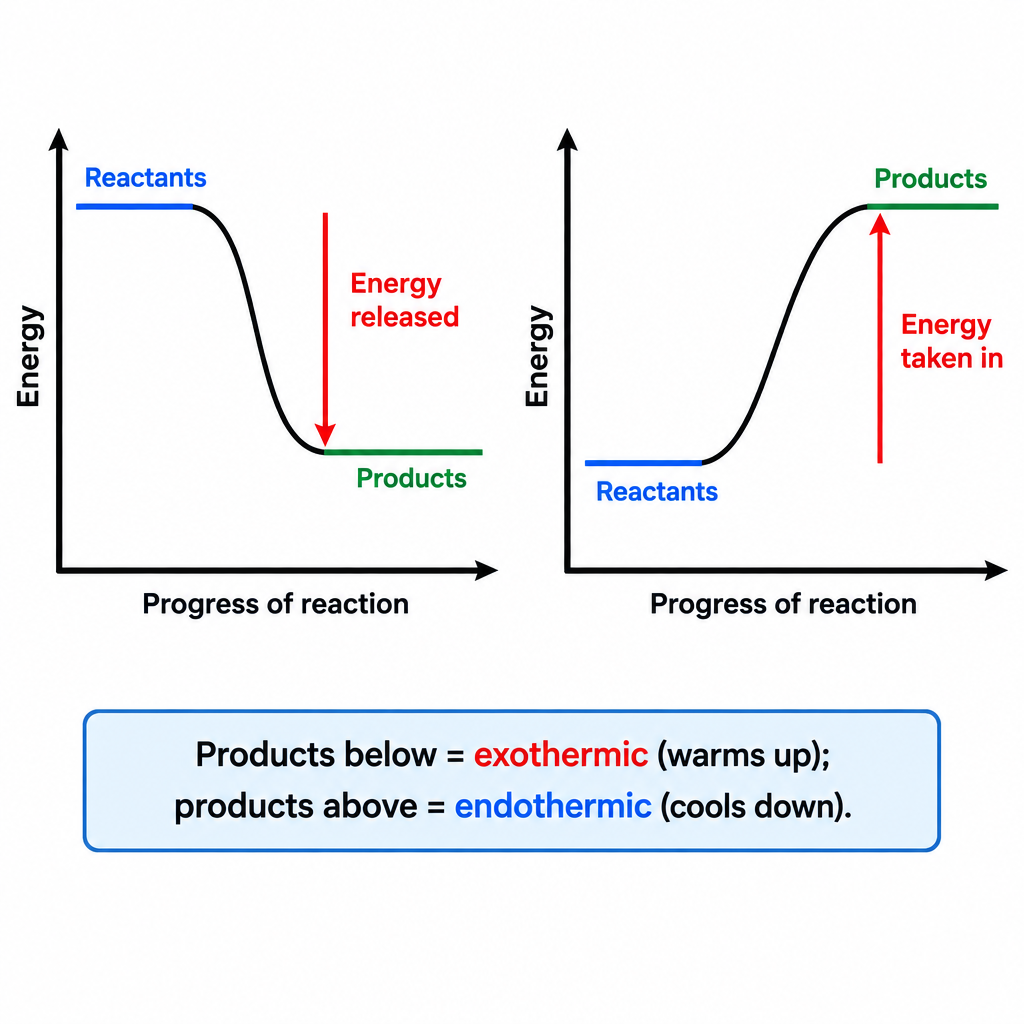
Key idea🔑 Key idea: Products below reactants = exothermic; above = endothermic. Bigger gap = more energy. 📈
Worked example
Worked Example: Products Up High
Energy Went In 🔺
On a pathway diagram the products are higher than the reactants. Exothermic or endothermic?
- 1Products higher → the chemicals gained energy, taken in from the surroundings.
- 2Energy in = endothermic.
Compare products to reactants, not to the bottom of the page. 🔺
---
5. Reading the Energy Gap
The vertical gap on the diagram isn't just decoration — it's the amount of energy transferred. For an exothermic reaction (products lower), that gap is the energy released to the surroundings. The bigger the drop, the more energy comes out, and the bigger the temperature rise you'd measure. Two exo diagrams side by side? The one with the bigger drop (the bigger gap) releases more energy.
Key idea🔑 Key idea: The gap between reactant and product levels = energy transferred. Bigger drop = more energy released. ↕️
Worked example
Worked Example: What's the Gap?
Energy Released 📏
Products are lower than the reactants. A gap labelled Q sits between the two levels. What is Q, and is the reaction exothermic or endothermic?
- 1Products below reactants → energy released → exothermic.
- 2The gap Q is the energy released to the surroundings.
Q = energy out, reaction = exothermic. 📏
---
6. Temperature Change
Nearly every number question starts here, and it's worth marks on its own. Temperature change = final temperature − initial temperature. Positive = it got hotter (exothermic); negative = it got colder (endothermic). When they only want the size, just take the difference and ignore the sign. Keep the same decimal places as the question, and subtract — never add (adding the two readings is the trap option, every time).
Key idea🔑 Key idea: Temperature change = final − initial. Subtract, don't add. Up = exo, down = endo. ➖
Worked example
Worked Example: Just Subtract
22.5 Degrees 🌡️
An acid's temperature rises from 24.0 °C to 46.5 °C. Work out the temperature change.
- 1change = final − initial = .
- 2, so the change is 22.5 °C.
Not 70.5 (that's adding), not 46.5 (that's the final reading). Subtract. ✅
---
7. Energy Transferred to Water
Got a temperature change? You can find the energy given to the water. You don't need to learn the relationship: questions that need it give it to you, and your job is to use it correctly. It looks like this: energy (J) = volume of water (cm³) × 4.2 × temperature change (°C). The answer is in joules. Find the temperature change first, put the three numbers in and multiply. The traps: use the volume of water (not the mass of any solid that dissolved) and the temperature change (not the final temperature), and don't divide by anything extra.
Key idea🔑 Key idea: The question supplies the relationship (energy = volume of water × 4.2 × temperature change). Use the volume of water and the change, then multiply. 🧮
Worked example
Worked Example: Run the Numbers
850.5 J 🔢
A reaction warms 15 cm³ of water by 13.5 °C. Work out the energy given out, using energy = temperature change × 4.2 × volume of water.
- 1energy = .
- 2, then , so 850.5 J.
Use all three numbers — leaving out the volume is the classic slip. 🔢
---
8. Fair Tests
Loads of marks come from "describe how you'd compare…" two fuels or two reactions. The chemistry is easy; the marks are for making it fair — change only the thing you're testing, keep everything else the same. For fuels heating water: same volume of water, same start temperature, same distance to the flame, same container. Then change only the fuel and measure one thing — time to reach a set temp, or temperature rise in a fixed time.
Key idea🔑 Key idea: Fair test = keep everything the same except the one thing tested, and measure one outcome. ⚖️
Worked example
Worked Example: Best Fuel
Time It ⏱️
How do you find which of several alcohols heats water fastest, fairly?
- 1Keep it fair: same volume of water, same start temperature, same distance from the burner, same container.
- 2Change only the alcohol and time how long each takes to reach a chosen temperature.
The shortest time heats the water fastest. "Biggest flame" isn't a measurement. ⏱️
---
9. Reducing Heat Loss
Real experiments lose heat to the air, which makes an exothermic temperature rise come out smaller than the true value (the reaction's still exothermic — your reading's just low). Fix it by losing less heat: wrap lagging (insulation) round the container, pop a lid on, or use a polystyrene cup instead of thin glass. Heat loss only ever makes the change look smaller — it never flips exothermic into endothermic.
Key idea🔑 Key idea: Heat loss makes the measured change too small. Lagging, a lid, or a polystyrene cup bring it closer to the true value. 🧥
Worked example
Worked Example: Wrap It Up
Lagging Works 🛡️
Heat is lost from a boiling tube in an exothermic reaction. State one change to make the measured temperature increase closer to the true value, and why.
- 1Heat lost → less energy warms the mixture → the measured increase is too low.
- 2Wrap lagging (insulation) round the tube: less heat escapes, so more stays in and the reading is closer to the true value.
A thinner tube would do the opposite — you want less heat loss. 🛡️
---
10. What Changes the Size
The same reaction can give a big or small temperature change. The idea: the same heat shared through more water = smaller change; through less water = bigger change. Classic case: magnesium + excess acid. The magnesium runs out (it's limiting), so the same heat is released every time — pour in more acid and that fixed heat is just spread thinner, so the rise is smaller. Plot results with a single line of best fit, and to read a value just past the points, extend the line (extrapolate) and read across — with the unit.
Key idea🔑 Key idea: Same heat, more water → smaller change. Use a line of best fit, and extend it to read past the points. 📊
Worked example
Worked Example: Off the Chart
Extend the Line 📐
A best-fit line of temperature change against volume of acid goes up to 40 cm³. How do you find the value at 45 cm³?
- 145 cm³ is past the points, so extend (extrapolate) the best-fit line smoothly to 45 cm³.
- 2Go up from 45 cm³ to the line, then across to the temperature axis, and read the value in °C.
Extend first, then read across, then write the unit. 📐
---
Practice this in the app
Unlock the full chapter: practice questions, flashcards, mock papers and notes, free.
Continue revising