Acids, Bases and Salts: Reactions, Indicators and Making Salts
H⁺ Energy: The Chemistry of Sour ⚗️
Introduction
1. Introduction
Okay, acids and bases sound intense, but honestly this whole chapter runs on one cheat code: an acid is just something that dumps hydrogen ions () into water. That's it. Every fizz, every colour change, every salt recipe traces back to that one ion.
Bases are the opposite vibe: they cancel acids out. And a base that dissolves in water (an alkali) drops hydroxide ions (). Acid meets alkali, they neutralise, you get water. Lock that in and the reactions, the pH scale, the oxides, and the salt-making recipes all click into place. This is your fast refresh, not the full textbook: one key idea per topic, one worked example, and exactly the move the marker wants. Let's get into it. ⚗️
Bases are the opposite vibe: they cancel acids out. And a base that dissolves in water (an alkali) drops hydroxide ions (). Acid meets alkali, they neutralise, you get water. Lock that in and the reactions, the pH scale, the oxides, and the salt-making recipes all click into place. This is your fast refresh, not the full textbook: one key idea per topic, one worked example, and exactly the move the marker wants. Let's get into it. ⚗️
2. Acids Are All About H⁺
Here's the thing that ties the whole chapter together: every single acid, no matter how fancy its name, releases the same ion in water, the hydrogen ion . Hydrochloric, sulfuric, nitric, all of them. That's why they all behave the same way. Alkalis are the mirror image: they release . When meets , they join up to make plain water, and that's neutralisation.
Key idea🔑 Key idea: Acids release ; alkalis release . They neutralise to water: . 💧
Worked example
Worked Example: The Ion in Every Acid
Worked Example: Spot What They Share 🔎
All acids in water contain the same ion. What's its formula: , , or ?
- 1Acids are defined by one ion: the hydrogen ion. Different acids have different other bits (HCl has , sulfuric has ), but they all share .
- 2So the ion in every acid is . ( is the alkali one, don't get baited.)
The thing they share is always the mark. ✅
---
Answer
3. The Three Reactions of Acids
Acids do three classic reactions, and each one makes a salt plus something extra. With a metal you get salt + hydrogen (it pops with a lighted splint). With a base (a metal oxide or hydroxide) you get salt + water. With a carbonate you get salt + water + carbon dioxide (the turns limewater milky). The acid decides the salt's surname: hydrochloric → chloride, sulfuric → sulfate, nitric → nitrate.
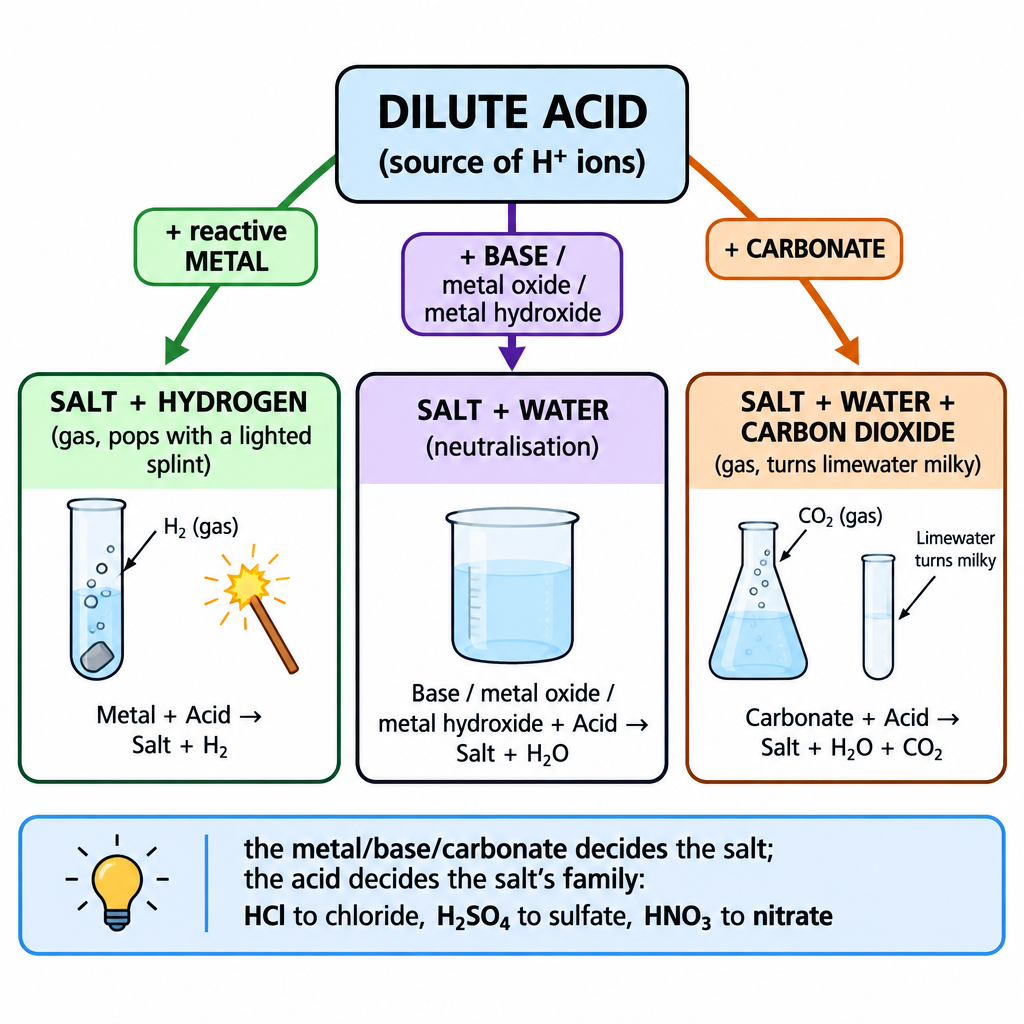
Key idea🔑 Key idea: Acid + metal → salt + hydrogen. Acid + base → salt + water. Acid + carbonate → salt + water + carbon dioxide. 🧂
Worked example
Worked Example: Carbonate Plus Acid
Worked Example: Name the Three Products 🫧
Magnesium carbonate reacts with nitric acid. What are the three products?
- 1Use the pattern: acid + carbonate → salt + water + carbon dioxide.
- 2Metal is magnesium, acid is nitric → the salt is magnesium nitrate. So the three products are magnesium nitrate, carbon dioxide and water.
Carbonates give carbon dioxide, not hydrogen, that's the trap. 🫧
---
Answer
4. Indicators and the pH Scale
Indicators are dyes that change colour to rat out whether something is acid or alkali. Three to memorise: litmus (red in acid, blue in alkali), thymolphthalein (colourless in acid, blue in alkali), and methyl orange (red in acid, yellow in alkali). For an actual number, universal indicator gives you the pH scale from 0 to 14: below 7 acidic, exactly 7 neutral (green), above 7 alkaline. Lower pH = more = more acidic.
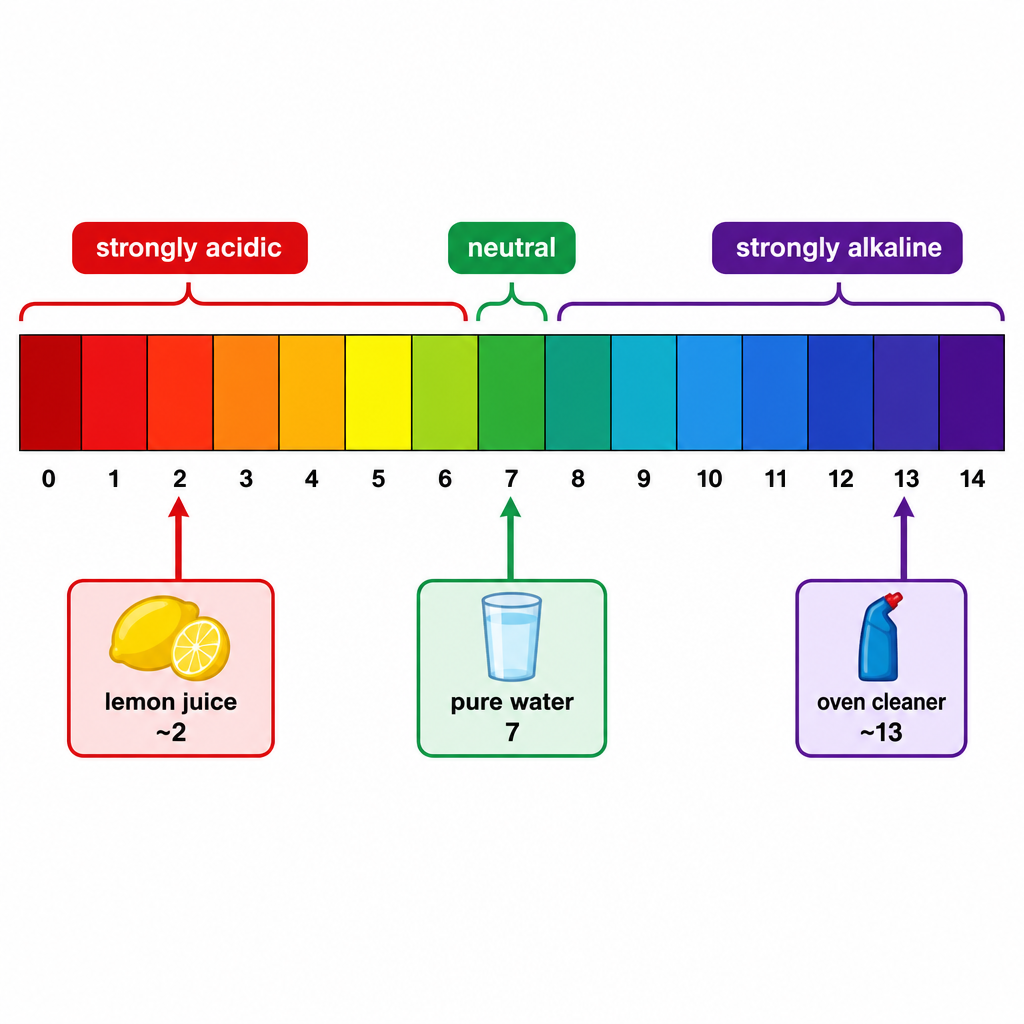
Key idea🔑 Key idea: Litmus red/blue, thymolphthalein colourless/blue, methyl orange red/yellow. pH 0–14: under 7 acid, 7 neutral, over 7 alkali. 🌈
Worked example
Worked Example: Two Indicators in Alkali
Worked Example: Pick the Right Column 🎨
Thymolphthalein is colourless in acid and blue in alkali. Methyl orange is red in acid and yellow in alkali. Both are added to sodium hydroxide. What colour is each?
- 1Sodium hydroxide is an alkali, so read the "in alkali" answers.
- 2Thymolphthalein → blue. Methyl orange → yellow.
Reminder: thymolphthalein is colourless in acid, not red, that's the classic bait. 🎨
---
5. Base vs Alkali
People mix these up constantly. A base is any metal oxide or hydroxide that neutralises an acid. An alkali is just a base that dissolves in water (and then gives ions). So every alkali is a base, but not every base is an alkali, because plenty of bases (like copper(II) oxide) don't dissolve. The deciding factor is literally: does it dissolve in water?
Key idea🔑 Key idea: Every alkali is a base, but only the soluble bases are alkalis. Insoluble bases (like CuO) are bases but not alkalis. 🧠
Worked example
Worked Example: Which Base Is an Alkali
Worked Example: Does It Dissolve? 💦
Which of these bases is also an alkali: sodium hydroxide, copper(II) oxide, iron(III) oxide or magnesium oxide?
- 1Alkali = a base that dissolves in water. So ask which one dissolves.
- 2Sodium hydroxide dissolves to give an alkaline solution → it's the alkali. The other three are insoluble metal oxides → bases only.
Solubility is the whole deciding factor. ✅
---
Answer
6. Sorting Oxides
Oxides split into two camps, and one question decides which: is the element a metal or a non-metal? Metal oxides are basic (they react with acids), like , CaO, CuO. Non-metal oxides are acidic (they react with alkalis), like , , . That's the whole rule: metal → basic, non-metal → acidic.
Key idea🔑 Key idea: Metal oxide = basic. Non-metal oxide = acidic. One question (metal or not?) sorts them. ⚖️
Worked example
Worked Example: Classify Phosphorus Oxide
Worked Example: Check the Element First 🧪
Is phosphorus(V) oxide an acidic or a basic oxide, and why?
- 1Is phosphorus a metal or a non-metal? It's a non-metal.
- 2Non-metal oxides are acidic. So phosphorus(V) oxide is acidic, because phosphorus is a non-metal.
The "why" is the mark: tie it back to metal-vs-non-metal. ✅
---
7. Solubility Rules
Before you can make a salt, you've got to know if it dissolves, because that picks the method. The safe-bets that always dissolve: anything sodium, potassium or ammonium, plus all nitrates. The usual non-dissolvers: most carbonates and most hydroxides, plus a few sneaky chlorides (silver, lead) and sulfates (barium, calcium, lead). Spot a sodium/potassium/ammonium/nitrate and you instantly know it's soluble.
Key idea🔑 Key idea: All sodium, potassium, ammonium salts and all nitrates are soluble. Most carbonates and hydroxides are insoluble. 🌊
Worked example
Worked Example: The All-Insoluble Set
Worked Example: Eliminate the Soluble Ones ❌
Which set is all insoluble? (a) calcium sulfate, magnesium hydroxide, silver chloride; (b) ammonium carbonate, silver chloride, sodium sulfate; (c) barium sulfate, calcium chloride, magnesium hydroxide; (d) calcium nitrate, magnesium carbonate, lead(II) hydroxide.
- 1Cross off any set with a sodium/potassium/ammonium/nitrate (always soluble): (b) has ammonium carbonate + sodium sulfate, (c) has calcium chloride, (d) has calcium nitrate. All out.
- 2That leaves (a) — calcium sulfate, magnesium hydroxide and silver chloride are all insoluble.
Eliminate the soluble ones and the answer falls out. ❌
---
Answer
8. Making Soluble Salts
For a salt that dissolves, you react an acid with the right thing, get rid of any leftover, then crystallise. If the other reactant is an insoluble base, carbonate or metal, use the excess solid method: pile in extra solid so all the acid is used up, filter off the leftover, then evaporate to the point of crystallisation. If the other reactant is a soluble alkali, you can't filter an excess, so you titrate to find the exact volume, then redo it with no indicator and crystallise.
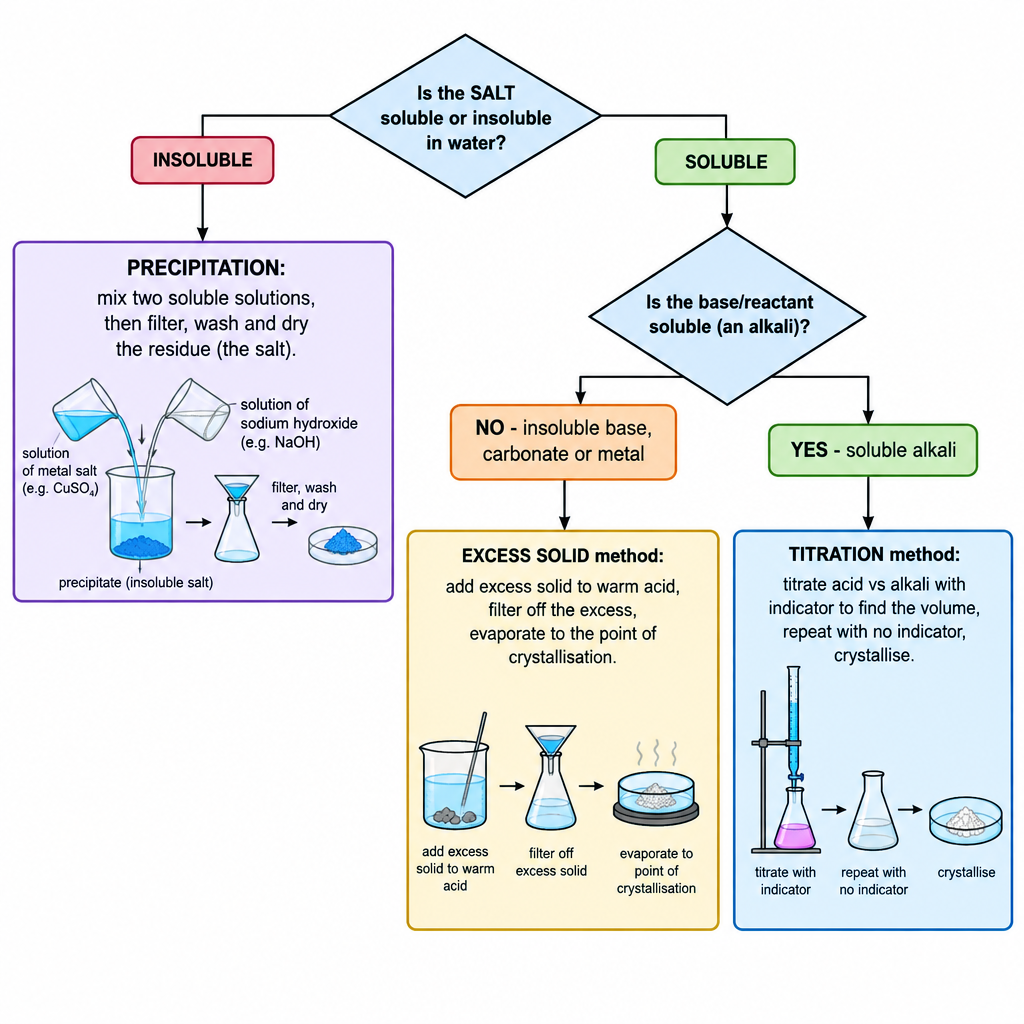
Key idea🔑 Key idea: Insoluble reactant → excess solid, filter, crystallise. Soluble alkali → titrate, repeat with no indicator, crystallise. 🧫
Worked example
Worked Example: Making Copper(II) Sulfate
Worked Example: Why Copper Metal Won't Do 🟦
Copper is less reactive than hydrogen, so it doesn't react with dilute acids. Which pair of reactants makes copper(II) sulfate?
- 1Copper metal is a no-go. Use a copper carbonate (or copper oxide) with sulfuric acid (acid + metal carbonate):
- 2Add it in excess, filter off the leftover, evaporate to the point of crystallisation, cool, and dry the blue crystals.
Excess insoluble solid = all the acid used up, easy to filter out. 🟦
---
9. Making Insoluble Salts
If the salt you want doesn't dissolve, you can't crystallise it from solution. Instead you mix two solutions that do dissolve, one bringing the metal and one bringing the non-metal part. The insoluble salt drops out as a solid (a precipitate). Then you filter it off, wash it with distilled water to rinse away the soluble leftovers, and dry it. This is called precipitation.
Key idea🔑 Key idea: Insoluble salt = mix two soluble solutions, then filter, wash and dry the precipitate. The salt is the solid on the paper. 🥅
Worked example
Worked Example: Pure Lead(II) Chloride
Worked Example: Keep the Solid, Wash the Rest 🧼
Lead(II) chloride is insoluble. It forms when sodium chloride solution is mixed with lead(II) nitrate solution. From the two solids, how do you get pure, dry lead(II) chloride?
- 1Dissolve each solid separately in distilled water, then mix the solutions, lead(II) chloride precipitates out.
- 2Filter to collect the solid, wash it with distilled water (to remove the soluble sodium nitrate), then dry it.
The salt is the residue on the filter paper, not the liquid. 🧼
---
10. Hydrated vs Anhydrous
Some salt crystals have water locked inside their structure, called water of crystallisation (written with a dot, like ). A salt with this water is hydrated (blue, for copper(II) sulfate). A salt with the water removed by heating is anhydrous (white). And aqueous just means dissolved in water. Heat blue → white; add water white → blue. That colour flip is actually the test for water.
Key idea🔑 Key idea: Hydrated = solid with built-in water (blue ). Anhydrous = no water (white ). Aqueous = dissolved. 💎
Worked example
Worked Example: The Three Forms of Copper Sulfate
Worked Example: Match Each Word 🔵
Copper(II) sulfate exists as aqueous, hydrated and anhydrous. Match each word to its meaning.
- 1Aqueous = dissolved in water (a solution).
- 2Hydrated = a solid chemically combined with water → blue . Anhydrous = a solid with no water → white .
So: aqueous = dissolved, hydrated = solid + water, anhydrous = dry solid. "Hydrated" means water inside a solid crystal, not just floating in solution. 🔵
---
Practice this in the app
Unlock the full chapter: practice questions, flashcards, mock papers and notes, free.
Continue revising